

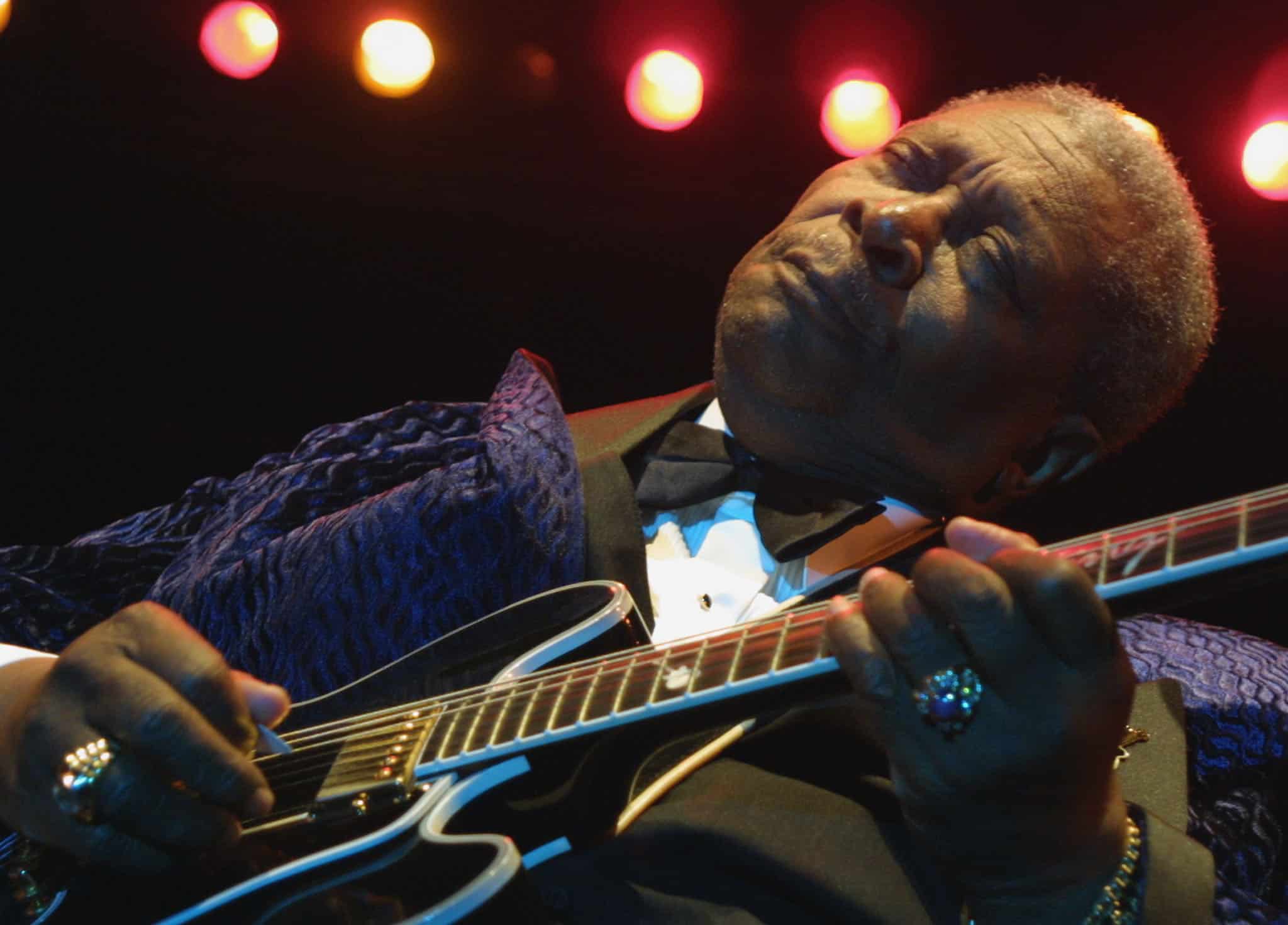
B.B. King, who rose from poverty on a Mississippi Delta cotton plantation to become one of the most influential guitarists of the 20th century and an ambassador for American blues music, has died. He was 89.
King died in his sleep at his home in Las Vegas late Thursday, the Associated Press said, citing his attorney, Brent Bryson. The death was confirmed by the Clark County coroner, the report said. King said on his website on May 1 that he was in hospice care at home.
With an electric guitar he named Lucille, King developed a signature style — single-note solos, left-hand vibrato and bent strings simulating a human cry — that beginning in the 1960s inspired a younger generation of blues and rock guitarists from Eric Clapton, Jimmy Page and Jeff Beck in Britain to Jimi Hendrix, Michael Bloomfield and Stevie Ray Vaughan in the U.S.
“Every guitar player in the world should stand up when B.B.’s name is mentioned,” Chicago bluesman Buddy Guy said in 1997, when King was presented with the Blues Foundation’s Lifetime Achievement Award.
King’s recording of the Roy Hawkins and Rick Darnell song “The Thrill Is Gone,” featuring his plaintive vocals and stinging guitar over a backdrop of violins, became one of the first blues songs to make the Top 20 on U.S. pop charts. The record earned King a Grammy Award in 1970 for best male rhythm and blues vocal performance. His subsequent television appearances on “The Ed Sullivan Show” and “American Bandstand” helped bring blues music from black-oriented radio stations and roadhouses into mainstream popular culture.
“Almost single-handedly, B.B. King introduced the blues to white America,” said music historian Peter Guralnick, according to a 2003 New York Times article.
During a career that spanned six-plus decades, King recorded more than 50 albums, won 15 Grammy Awards and notched about 75 entries on Billboard’s rhythm and blues charts between 1951 and 1985. He played in about 90 countries, had an audience with Pope John Paul II and sipped tea with Queen Elizabeth II.
King often collaborated with younger acolytes. A 2000 album with Clapton, “Riding With the King,” sold more than 4.5 million copies, the most in King’s career, according to the Times.
“He’s a shining example of consistency and dignity and carrying that ‘King’ crown very high for all of us,” guitarist Carlos Santana told Dan Aykroyd, co-author of “Elwood’s Blues: Interviews With the Blues Legends & Stars.”
King was inducted into the Rock and Roll Hall of Fame in 1987, the same year the National Academy of Recording Arts and Sciences honored him with a Lifetime Achievement Grammy. In 2006, President George W. Bush awarded him the Presidential Medal of Freedom, the nation’s highest civilian award.
Riley B. King — he was never sure what the “B” stood for — was born on Sept. 16, 1925, in a sharecropper’s cabin in Itta Bena, Mississippi, near Indianola. His parents, Albert and Nora Ella, separated when he was about 4, and he was raised by his mother, who called the blues “devil’s music,” and maternal grandmother in Kilmichael, in the hills east of the Delta, until they died in 1935 and 1940, respectively.
King walked six miles round-trip to a segregated one-room schoolhouse and earned 35 cents a day picking cotton. He attended church, where the preacher played guitar while singing spirituals, and King became fascinated with both the instrument and gospel music.
https://www.youtube.com/watch?v=mqUhdBAJfsk
Living on his own, he attended school and worked for a white plantation owner, Flake Cartledge, who advanced him a few dollars to buy his first guitar. By the end of 1942, King moved back to the Delta.
There, he picked cotton and drove a tractor, listening to music in his spare time. He accompanied a gospel group, “The Famous St. John’s Gospel Singers,” on guitar. Most important, he began singing the blues.
“On Saturday evenings, I would go into town and sit on a corner on Indianola and Church Street,” King said, according to the Times story. “When I played gospel songs, people would always compliment me, pat me on the head and say, ‘That’s great, son, keep it up.’ But no money. Nothing in the hat. But I’d sing blues songs, and I’d make $15 a night. And some songs I’d only change ‘my Lord’ to ‘my baby.’ ”
Although physically fit, King was discharged from the U.S. Army after basic training in 1944 because he drove a tractor for an essential industry, cotton.
At 20, King left Mississippi for the first time, heading 120 miles north to Memphis, where he connected with his mother’s cousin, the noted bluesman Bukka White.
Around that time, he married Martha Denton. They divorced in 1952 and had no children, according to a chronology created by Charles Sawyer Jr., a consultant to the B.B. King Museum and Delta Interpretive Center in Indianola and an instructor at Harvard University.
White taught King the art of the blues: how to hold the guitar and phrase the lyrics. During this formative stage, King was also influenced by Texas electric guitar pioneer T-Bone Walker and jazz guitarists Django Reinhardt and Charlie Christian.
King soon began to develop his own guitar style. He never played while singing. When he finished a verse, he would extend the vocal line with a guitar solo.
“When I sing, I play in my mind,” he once said. “The minute I stop singing orally, I start to sing by playing Lucille.”
His first big break came in 1948 on a radio show hosted by Sonny Boy Williamson, the famed blues harmonica player, on KWEM in West Memphis, Arkansas. King performed and listeners flooded the station with calls asking about the then-unknown musician.
He soon landed a steady gig at the Sixteenth Avenue Grill in West Memphis, and then earned a 10-minute spot on a local radio station with a pioneering all-black format. His on-air name became “Beale Street Blues Boy,” later shortened to “Blues Boy” and finally “B.B.”
At one early performance, in Twist, Arkansas, a fight broke out among fans who knocked over a kerosene stove, setting fire to the hall. King raced outside to safety along with everyone else. Realizing he had left his $30 guitar inside, he rushed back into the burning building to retrieve it, narrowly escaping death, he recounted in 1999 to William Ferris, then-chairman for the National Endowment of the Humanities.
King later learned that the fight had been over a woman named Lucille and decided to name his guitar after her to commemorate the event. Subsequently, Lucille was the name he gave every guitar he played.
During the 1950s, King had more than 10 singles reach the Top 20 on the R&B charts, including several No. 1 hits. By the end of the decade, he was performing as many as 340 one-night stands a year.
In 1958, he married Sue Hall, the daughter of an Indianola nightclub owner. The couple divorced in 1966 and had no children.
King’s manager, Sidney Seidenberg, began promoting King to white audiences. In 1968, he booked King at Bill Graham’s legendary Fillmore West in San Francisco. The following year the Rolling Stones chose him to open 18 of their concerts.
After the success of “The Thrill is Gone,” King began performing 300 shows a year in mainstream venues worldwide.
After he was diagnosed with diabetes in 1990, he continued appearing at more than 200 concerts a year, usually sitting down. He reached younger audiences at the Bonnaroo Music Festival in Tennessee in 2008, Britain’s Glastonbury Festival in 2011 and the New Orleans Jazz & Heritage Festival in 2013.
King was also a successful pitchman and entrepreneur. He endorsed products and companies such as Burger King, XM Satellite Radio, Northwest Airlines, OneTouch glucose-monitoring systems and Gibson Guitars, maker of his beloved Lucille. He opened the first B.B. King’s Blues Club on Beale Street in Memphis in 1991, then expanded to cities including New York, Los Angeles and Nashville.
King slowed his studio activities in later years. His 1993 album, “Blues Summit,” was considered a return to form and featured duets with peers such as John Lee Hooker, Etta James and Koko Taylor.
“I’m trying to get people to see that we are our brother’s keeper,” King said in “The B.B. King Reader” (1997). “Red, white, black, brown or yellow, rich or poor, we all have the blues.”
© 2015, The Washington Post





